Overview of Motor Grader Applications: Understanding Their Role in Infrastructure Projects
In infrastructure projects—such as highway construction, rural road upgrades, and site development—the motor grader serves as an indispensable piece of machinery for precision leveling. Unlike excavators or bulldozers, which primarily focus on earthmoving and stockpiling, a motor grader utilizes an adjustable, multi-angle blade to perform high-precision scraping, leveling, and shaping. Because of this versatility, it is widely used across various sectors, including highway construction, municipal engineering, agricultural land development, and industrial site preparation. For project procurement officers and construction managers, understanding the operational scope of a motor grader is crucial during the equipment selection process. Below is a comprehensive breakdown of the primary construction scenarios and core functions of motor graders.
I. New Highway Construction and Expansion/Reconstruction: Precision Shaping of Subgrades and Pavements
Highway construction represents the primary application for motor graders. During the subgrade phase, the machine is used to spread and level backfilled earth, ensuring that the subgrade elevation and cross-slope meet design specifications. It is also employed to trim subgrade slopes to the required gradient, helping to prevent landslides and soil erosion caused by rainwater runoff.
Prior to the construction of pavement layers on lower-class roads, motor graders are used to perform precision leveling on crushed-stone base courses and stabilized soil layers, creating a solid foundation for subsequent paving work. In highway expansion and reconstruction projects, motor graders can efficiently reshape widened subgrades and ensure smooth transitions between new and existing pavement. Compared to manual leveling, they offer superior precision and faster execution, effectively shortening construction timelines.
II. Urban and Rural Road Maintenance: Routine Pavement Upkeep
Rural roads, industrial site access roads, and temporary haul roads in mining areas are prone to developing issues such as potholes, ruts, and surface heaving after prolonged use. In these contexts, the motor grader serves as the primary piece of equipment for road maintenance.
In routine maintenance, a motor grader can shave off raised sections of a road surface and backfill or level out potholes, restoring the road’s smoothness. It can also clear roadside ditches and unblock drainage channels, preventing water accumulation from saturating the roadbed and thereby extending the road's service life.
For low-cost roads—such as those connecting rural villages or gravel tracks through farmlands—a motor grader can be used to periodically re-grade and reshape the entire surface. Since the work on these roads is often scattered and limited in scale at any single location, the motor grader’s high mobility makes it exceptionally well-suited for the ongoing, routine maintenance of rural road networks.
III. Site Leveling: Industrial Facilities, Storage Yards, and Airport-Related Infrastructure
Motor graders are also frequently used for leveling ground at industrial sites, aggregate storage yards, parking lots, logistics parks, and areas surrounding airports. While bulldozers are effective for rough grading, achieving precise design elevations and uniform slopes requires the fine-grading capabilities of a motor grader. A properly leveled site facilitates subsequent paving or gravel application and ensures effective drainage, preventing localized water pooling.
In large open-air storage yards, long-term material stockpiling often leads to an uneven, undulating surface. Periodic leveling with a motor grader keeps the site organized, allowing loaders and trucks to move in and out efficiently for material transport, ultimately maximizing the site's utility.
IV. Water Conservancy and Agricultural Projects: Ditch Excavation and Land Preparation
In high-standard farmland improvement projects, motor graders are used to level uneven fields, transforming them into smooth, uniform plots that facilitate mechanized sowing and irrigation. Furthermore, they are employed to excavate and shape agricultural irrigation and drainage ditches—forming them into standardized trapezoidal cross-sections—to ensure the efficient flow of water for both irrigation and drainage purposes.
For slope-grading projects on small embankments or drainage ditches, a motor grader allows for precise, remote control of the blade angle. Compared to a small excavator, a motor grader produces a straighter, smoother slope surface, making it ideal for large-scale, linear water conservancy infrastructure projects.
V. Expanding Capabilities with Attachments: Ripping, Snow Clearing, and Breaking Hard Soil
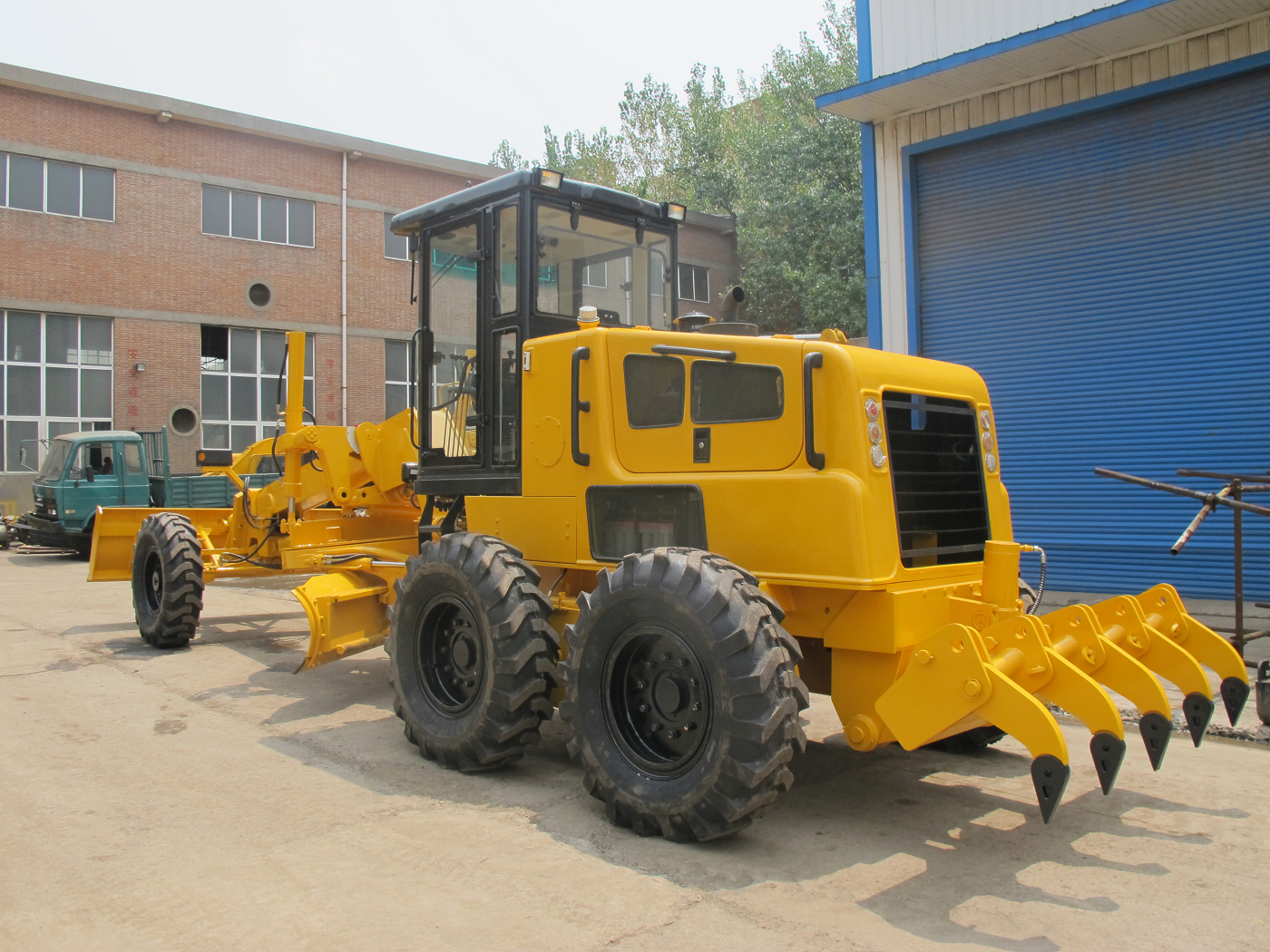
Motor graders support a variety of attachments, enabling a single machine to perform multiple functions. Equipped with a rear-mounted ripper, the machine can break up compacted soil or weathered rock layers—loosening the ground before grading—which overcomes the difficulty of leveling hard, unyielding terrain. When fitted with a front-mounted snow blade, it becomes an essential tool for clearing snow from highways, industrial sites, and rural roads during winter in northern regions, ensuring continued road accessibility.
In certain operating conditions, a harrow or rake attachment can also be used to clear surface debris and break up soil clods. This further broadens the motor grader’s utility, allowing one machine to handle diverse tasks and helping project owners reduce equipment procurement costs.
VI. Selecting a Motor Grader and Operational Considerations
Different construction scenarios require different motor grader configurations. For rural road maintenance or work on smaller sites, small-to-medium-sized motor graders are preferable due to their superior maneuverability and lower fuel consumption. For major highway projects or large-scale infrastructure development, high-horsepower models are better suited, offering greater operational stability and higher leveling precision. If the work frequently involves hard soil, a rear-mounted ripper is recommended; for regions with winter snowfall, a front-mounted snow blade can be added as an optional accessory.
The core value of a motor grader lies in high-precision shaping and leveling. It is not designed for moving large volumes of earth—a task better suited for a bulldozer—nor is it intended for deep excavation. Matching the machine to the appropriate operating conditions is key to fully leveraging its advantages.
As domestic infrastructure development continues to advance and rural road networks are further improved, there remains a stable, long-term demand for motor graders in applications such as highway construction, road maintenance, and farmland improvement. By becoming familiar with the various scenarios in which motor graders can be utilized, construction entities can effectively plan their work sequences and make informed selections of construction machinery, thereby enhancing both project quality and operational efficiency.
 Hot News
-
On-Site Field Testing of a Bulldozer: A Real-World Construction Scenario
2026-11-11
-
Heavy-Duty Construction Bulldozer Assembled and Ready for Shipment to Overseas Project Site
2026-11-11
-
Overview of Motor Grader Applications: Understanding Their Role in Infrastructure Projects
2026-11-11
-
3-Ton Compact Excavator: Versatile Micro-Excavator for Residential, Municipal, Landscaping, and Agricultural Use
2026-11-10
-
24-Ton Crawler Excavators Ready for Export: Versatile Solutions for Earthworks, Mining, and More
2026-11-10
-
Bulldozer Exports | Direct-from-Factory Supply of Crawler Bulldozers for Overseas Markets
2026-11-10